
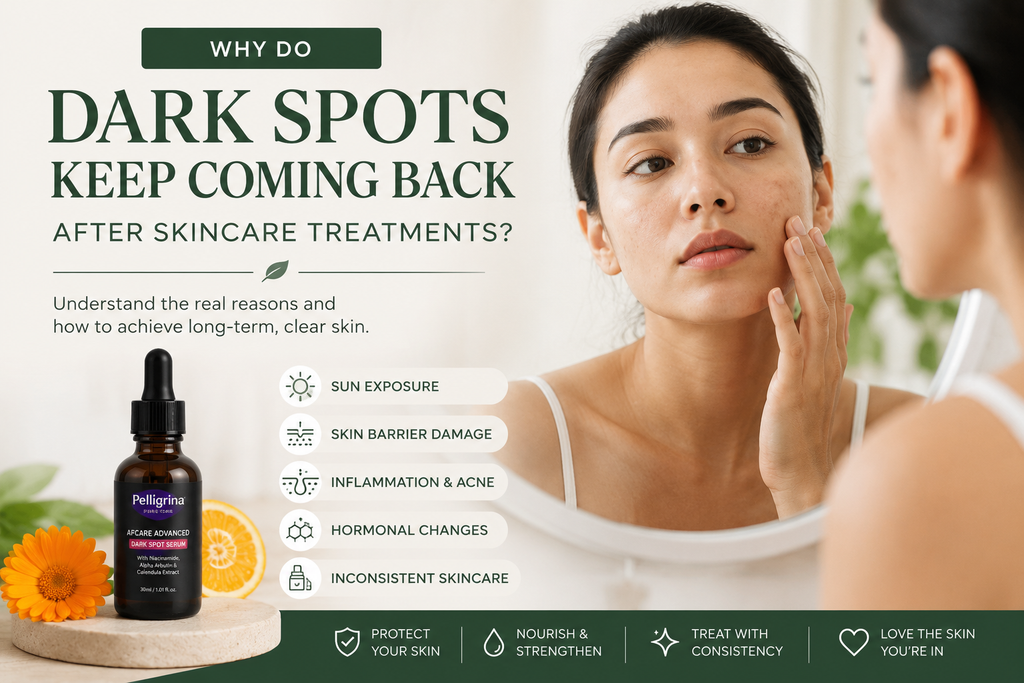
Why Do Dark Spots Keep Coming Back After Skincare Treatments?
If you’ve been using skincare products to reduce dark spots but still notice them returning after some time, you’re not alone. This is one of the most common skincare frustrations people search for today.
Many users expect that once a dark spot fades, it should stay gone permanently. But in reality, pigmentation is a recurring skin response, not just a surface-level issue.
To understand why this happens, we need to look deeper into how skin behaves, how pigmentation is formed, and why some treatments only deliver temporary results.
Why do dark spots come back even after treatment?
Dark spots, also known as hyperpigmentation, occur when the skin produces excess melanin in response to triggers like sun exposure, acne, inflammation, or hormonal changes.
Most skincare treatments focus on fading the visible mark on the surface. However, they often do not fully address the underlying triggers that caused the pigmentation in the first place.
So even if a spot fades, the skin remains “reactive” in that area. This means that when exposed again to sunlight or irritation, pigmentation can easily return.
This is the main reason people experience a cycle of:
fade → improve → return again
The biggest hidden trigger: sun exposure
One of the most overlooked reasons dark spots return is daily UV exposure.
Even if you are not directly under the sun for long periods, UV rays can still affect the skin through windows, outdoor walks, or indirect exposure.
UV exposure activates melanin production, which can reactivate pigmentation in previously treated areas.
This is why dermatologists always emphasize that dark spot treatment is incomplete without consistent sun protection.
Without it, even the best skincare routine can only deliver temporary improvement.
Why skincare treatments alone are not enough
Many people rely heavily on serums, creams, or treatments to remove pigmentation. While these products can help improve appearance, they often do not address skin stability.
Here’s what usually happens:
- Treatment reduces visible pigmentation
- Skin looks clearer for a while
- Trigger (sun/inflammation) continues
- Pigmentation returns
This doesn’t mean the products are ineffective, it means skincare must be consistent and supportive, not reactive.
Long-term results come from combining treatment with prevention and barrier support.
Skin barrier health plays a major role
The skin barrier is the outer protective layer that controls moisture and defends against environmental stress.
When the barrier is weak, skin becomes more sensitive and reactive. This increases the chances of pigmentation forming again even after treatment.
Common causes of barrier damage include:
- Over-exfoliation
- Harsh skincare products
- Pollution exposure
- Lack of hydration
A damaged barrier makes it easier for inflammation to trigger melanin production again, which leads to recurring dark spots.
Why consistency matters more than intensity
One of the biggest mistakes in skincare is switching products too often or expecting fast results.
Pigmentation develops over time, and it also requires time to improve and stabilize.
Instead of aggressive treatments, what works better is a consistent routine that focuses on:
- Gentle cleansing
- Skin hydration
- Targeted treatment
- Daily sun protection
Consistency allows the skin to gradually rebuild balance, making pigmentation less likely to return.
Where targeted serums fit into the routine
Targeted serums are designed to support specific skin concerns like uneven tone and dark spots.
Unlike heavy creams, serums are lightweight and can deliver active ingredients more effectively into the skin.
For example, the Afcare Advanced Dark Spot Serum available at Pelligrina is designed for individuals dealing with uneven skin tone and recurring pigmentation concerns. It is often used as part of a consistent skincare routine rather than a one-time solution.
When used regularly along with sun protection and barrier-friendly skincare habits, it can support a more stable and even-looking complexion over time.
Why dark spots feel like they “return stronger”
In many cases, dark spots don’t actually return stronger, they simply become more visible again due to:
- New sun exposure
- Ongoing inflammation
- Lack of maintenance routine
- Weak skin barrier recovery
This creates the impression that treatment has failed, when in reality, the skin is just responding again to external triggers.
The correct way to think about pigmentation
Instead of thinking of dark spots as something you “remove once,” it’s more accurate to think of them as something you manage long-term.
Skin is constantly adapting to its environment. That means pigmentation control is an ongoing process, not a one-time fix.
Once this mindset shifts, skincare becomes more effective and less frustrating.
FAQs
Why do dark spots come back after fading?
Because the underlying triggers like sun exposure and inflammation are still present, which reactivate melanin production.
Can skincare permanently remove dark spots?
Skincare can significantly reduce pigmentation, but ongoing care is required to maintain results.
How important is sunscreen in dark spot treatment?
Very important. UV exposure is one of the biggest reasons pigmentation returns.
How long does it take to see stable results?
It varies, but consistent use over several weeks to months is usually required.
Do serums really help with recurring pigmentation?
Yes, when used consistently as part of a full routine including sun protection and hydration.
Final Thoughts
Dark spots are not just a surface issue, they are a recurring skin response influenced by environment, skin health, and daily habits.
Instead of focusing on quick fixes, the most effective approach is consistency, protection, and barrier support.
A well-structured routine, combined with targeted skincare like the Afcare Advanced Dark Spot Serum, can help support a more even and stable-looking complexion over time.
To explore more skincare solutions and routines, visit Pelligrina and build a consistent approach to long-term skin health.
Related post
31
Jul